Friday, February 13, 2015

Spring Bloomers, Petunia Edition

Petunia x hybrida
    Garden Petunia


Type    Annual
Height    6" to 15" / 15cm to 40cm
Spread    8" to 12" / 20cm to 30cm
Growth rate    Average
Form    Spreading or horizontal
Exposure    Partial shade or partial sun to full sun


Bloom Color    Pink, purple, red, white and yellow
Bloom Time    Spring through Fall

The flowers are fragrant and suitable for cut flowers.


Environment
This plant will grow in moist soil.
Suitable soil is well-drained/loamy, sandy or clay.
The pH preference is  a neutral soil.


Leaf Color    Green
This plant has fragrant foliage.


Culture Notes
Plants prefer a sunny, well-drained soil.  Most plants tend to flop with age.  Removal of spent flowers encourages more blooms.  Cultivars are not reliable from seed.  Stem cuttings can be taken and rooted in the summer.


Petunia x hybrida 'Primetime Plum'
    Garden Petunia


Type    Annual
Height    8" to 15" / 20cm to 40cm
Growth rate    Fast
Form    Irregular or sprawling
Exposure    Partial shade or partial sun to full sun


Bloom Color    Purple
Bloom Time    Spring through Fall

The flowers are fragrant and suitable for cut flowers.


Environment
This plant tolerates drought.
This plant will grow in dry to moist soil.
Suitable soil is well-drained/loamy or sandy.
The pH preference is  a neutral soil.


Leaf Color    Green
This plant has fragrant foliage.


Culture Notes
Excellent plant for massing in beds, borders, and containers.  Pinching off dead blooms will encourage continuous blooming.  These plants do very well in hot, dry climates.


Petunia x hybrida 'Celebrity Chiffon Morn'
    Garden Petunia

Type    Annual
Height    12" to 18" / 30cm to 45cm
Spread    12" to 14" / 30cm to 35cm
Growth rate    Fast
Form    Upright or erect
Exposure    Full sun


Bloom Color    Pink
Bloom Time    Spring through Fall

The flowers are fragrant, showy and suitable for cut flowers.


Environment
This plant tolerates drought.
This plant will grow in moist soil.
Suitable soil is well-drained/loamy or sandy.
The pH preference is  a neutral soil.


Leaf Color    Green
This plant has fragrant foliage.


Culture Notes
Winner of the 1995 All-America Selections bedding plant award.  This plant does excellent in containers due to its drought tolerance. Soft pastel pink flowers with white centers works well with other flowering plants.  'Celebrity Chiffon Morn' shows exceptional weather tolerance.
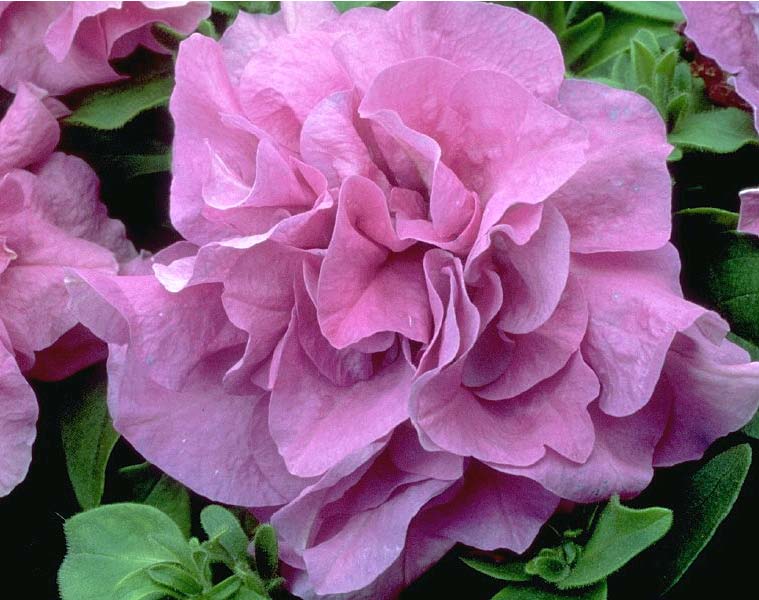


Petunia x hybrida 'Heavenly Lavender'
    Garden Petunia


Type    Annual
Height    10" to 12" / 25cm to 30cm
Spread    18" to 24" / 45cm to 60cm
Growth rate    Average
Form    Rounded
Exposure    Full sun


Bloom Color    Lavender
Bloom Time    Spring through Fall

The flowers are fragrant and suitable for cut flowers.


Environment
This plant will grow in moist soil.
Suitable soil is well-drained/loamy, sandy or clay.
The pH preference is  a neutral soil.


Leaf Color    Green
This plant has fragrant foliage.


Culture Notes
'Heavenly Lavender' was chosen by All-America Selections as a 1996 bedding plant winner.  These double-flowered plants are more compact and branching in full sun.   Removal of spent flowers encourages more blooms.  Stem cuttings can be taken and rooted in the summer.


Petunia x hybrida 'Fantasy Pink Morn'
    Garden Petunia

Type    Annual
Height    10" to 12" / 25cm to 30cm
Spread    12" to 18" / 30cm to 45cm
Growth rate    Average
Form    Rounded
Exposure    Full sun

Bloom Color    Pink
Bloom Time    Spring through Fall

The flowers are fragrant and suitable for cut flowers.

Environment
This plant will grow in moist soil.
Suitable soil is well-drained/loamy, sandy or clay.
The pH preference is  a neutral soil.

Leaf Color    Green
This plant has fragrant foliage.

Culture Notes
'Fantasy Pink Morn' was chosen by All-America Selections as a 1996 bedding plant winner.  This petite petunia is about 2/3 the size of a normal petunia.  It has light pink blossoms with creamy white centers and prefers a sunny, well-drained soil.  Unlike other petunias, this plant does not require pruning mid season to maintain a compact shape.  Cultivars are not reliable from seed.  Stem cuttings can be taken and rooted in the summer.

Thursday, February 12, 2015

Featured Plant of the Day: Chinese Fringe Bush

Loropetalum chinense var. rubrum 'Burgundy'
Chinese Fringe Bush

Type Shrub, woody plant
Hardy range 7A to 10A
Height 12' to 20' / 3.60m to 6.00m
Spread 10' to 15' / 3.00m to 4.60m
Growth rate Average
Form Rounded
Exposure Partial shade or partial sun to full sun
Persistence Evergreen

Bloom Color Red
Bloom Time Spring

The flowers are fragrant and very showy.

Environment This plant tolerates some drought.
This plant will grow in dry soil.
Suitable soil is well-drained/loamy, sandy or clay.
The pH preference is an acidic to slightly alkaline (less than 6.8 to 7.7) soil.

Leaf Color Purple
Fall Color No change in fall color

Culture Notes Fringebush prefers an acid soil pH and a mostly sunny position in the landscape. Its small size makes it well suited for planting in back of a shrub border or for use as a small tree near the patio. Mass several together to make a dramatic statement and a nice, delicate flower show. It can be trained into a nice espalier. Plant may be listed as a cultivar of the variety rubrum.
Planting and establishing shrubsThe most common cause of young plant failure is planting too deep. Plant the root ball no deeper than it was in the nursery. In most instances, the root flare zone (point where the top-most root in the root ball originates from the trunk) should be located just above the landscape soil surface. Sometimes plants come from the nursery with soil over the root flare. If there is soil over this area, scrape it off. The planting hole should be at least twice the width of the root ball, preferably wider. In all but exceptional circumstances where the soil is very poor, there is no need to incorporate anything into the backfill soil except the loosened soil that came out of the planting hole. Never place ANY soil over the root ball. If a row or grouping of plants is to be installed, excavating or loosening the soil in the entire bed and incorporating organic matter enhances root growth and establishment rate.
Weed suppression during establishment is essential. Apply a 3-inch thick layer of mulch around the plant to help control weed growth. Keep it at least 10 inches from the trunk. If you apply it over the root ball, apply only a one or two inch layer. This allows rainwater and air to easily enter the root ball and keeps the trunk dry. Placing mulch against the trunk or applying too thick a layer above the root ball can kill the plant by oxygen starvation, death of bark, stem and root diseases, prevention of hardening off for winter, vole and other rodent damage to the trunk, keeping soil too wet, or repelling water. Regular irrigation through the first growing season after planting encourages rapid root growth, which is essential for quick plant establishment.

Wednesday, February 11, 2015

Featured Plant of the Day: Hardy Orchid


Bletilla striata
    Chinese Ground Orchid,  Hyacinth Bletilla,  Hardy Orchid

Type    Perennial
Hardy range    5B to 9B
Height    10" to 18" / 25cm to 45cm
Growth rate    Average
Form    Irregular or sprawling
Exposure    Partial shade or partial sun
Persistence    Evergreen

Bloom Color    Lavender
Bloom Time    Spring and Summer

Environment
This plant will grow in wet soil.
Suitable soil is well-drained/loamy.
The pH preference is  a neutral soil.

Leaf Color    Green

Landscape Uses
-    Container plantings
-    Rock garden
-    Woodland garden
-    Border
-    Specimen

Attributes and Features
-    Attracts birds

Propagation and Root Form
Propagation is from  division.
This plant grows from a  corm.

Culture Notes
Soil should not dry out, as this will cause less flowering on the plant the next season.   Mulch deeply when in the northern climates, but dig the bulbs when frost is near and store them inside.  Otherwise, a deep mulch will provide protection.  With milder winters, plant about 1" deep in the fall; otherwise, plant as soon as possible in the spring.  Keep cool and dry once the ribbed leaves have fallen.  The rare cultivar, 'Alba', will flower white.

Tuesday, February 10, 2015

Featured Plant of the Day: 'Trail Blazer' Rhododendron

Rhododendron (subgenus Rhododendron) 'Trail Blazer'
    Rhododendron

Type    Shrub, woody plant
Hardy range    5B to 6A
Height    4' to 5' / 1.20m to 1.60m
Spread    4' to 5' / 1.20m to 1.60m
Growth rate    Fast
Form    Rounded
Exposure    Partial shade or partial sun
Persistence    Evergreen

Bloom Color    Pink
Bloom Time    Spring and Summer

The flowers are very showy.

 Environment
This plant will grow in moist soil.
Suitable soil is well-drained/loamy or sandy.
The pH preference is an acidic (less than 6.8) soil.

Leaf Color    Green
Fall Color    No change in fall color

 Landscape Uses
-    Woodland garden
-    Border
-    Massing

 Attributes and Features
-    Inconspicuous fruit

 Culture Notes
Partially shaded location gives good growth, provided drainage is adequate. Roots rot in soil that drains poorly. I (Dr. Gilman) have had no trouble transplanting these plants balled in burlap, although many are grown in containers. Pinch back the flowers after they have faded to eliminate the brown developing fruit if you wish. However, this is not essential for good flowering the following year. After all, these plants have been flowering quite nicely without our intervention. This plant is considered mostly allergy free and causes little or no allergy problems in most people.  Organic amendments in the backfill help establish plants quickly by encouraging roots to grow out of the container and into backfill soil.

Rhododendrons are ornamental, ericaceous, broad-leaved evergreens.  Azaleas belong to this genus, but many are not evergreen.  They grow best in shade or partial shade.  A south or southwest exposure increases the chance of winter injury to evergreen types when grown in northern climates.  Plant in an acidic, moist, well-drained soil with a pH between 4.5 and 6.5.  Transplanting balled and burlapped or potted plants is most successful.  The shallow root systems are easily injured by deep cultivation, but benefit from mulching.

Plants fail to absorb iron and have yellow leaves with green veins if the soil is not sufficiently acidic.  Finely ground sulphur can be added to the soil to increase acidity.  Have the soil tested before planting in order to determine the pH. Apply a 2:1:1 N:P:K ratio fertilizer two or three times each year before and after blooming and perhaps again as plants enter dormancy - timing is not as critical as previously believed.   Prevent winter burn in northern climates by avoiding exposed planting sites and by shading during winter.

'Trail Blazer' has a vigorous growth pattern and sports light pink blossoms with deep red, center blotches.

Planting and establishing shrubs

The most common cause of young plant failure is planting too deep.  Plant the root ball no deeper than it was in the nursery.  In most instances, the root flare zone (point where the top-most root in the root ball originates from the trunk) should be located just above the landscape soil surface. Sometimes plants come from the nursery with soil over the root flare. If there is soil over this area, scrape it off.  The planting hole should be at least twice the width of the root ball, preferably wider.  In all but exceptional circumstances where the soil is very poor, there is no need to incorporate anything into the backfill soil except the loosened soil that came out of the planting hole.  Never place ANY soil over the root ball. If a row or grouping of plants is to be installed, excavating or loosening the soil in the entire bed and incorporating organic matter enhances root growth and establishment rate.

Weed suppression during establishment is essential.  Apply a 3-inch thick layer of mulch around the plant to help control weed growth.  Keep it at least 10 inches from the trunk.  If you apply it over the root ball, apply only a one or two inch layer.   This allows rainwater and air to easily enter the root ball and keeps the trunk dry.  Placing mulch against the trunk or applying too thick a layer above the root ball can kill the plant by oxygen starvation, death of bark, stem and root diseases, prevention of hardening off for winter, vole and other rodent damage to the trunk, keeping soil too wet, or repelling water.  Regular irrigation through the first growing season after planting encourages rapid root growth, which is essential for quick plant establishment.


Monday, February 9, 2015

Featured Plant of the Day: 'Bullseye' Mountain Laurel

 Kalmia latifolia 'Bullseye'
Mountain Laurel,  Calico Bush,  Ivy
Type    Shrub, woody plant
Hardy range    4A to 8A
Height    6' to 10' / 1.80m to 3.00m
Spread    6' to 10' / 1.80m to 3.00m
Growth rate    Slow
Form    Oval
Exposure    Full shade to full sun
Persistence    Evergreen

Bloom Color    Purple and white
Bloom Time    Spring

The flowers are very showy.

Environment
This plant tolerates some drought.
This plant will grow in dry soil.
Suitable soil is well-drained/loamy or clay.
The pH preference is an acidic to neutral (less than 6.8 to 7.2) soil.

Leaf Color    Green
Fall Color    No change in fall color

Landscape Uses
-    Rock garden
-    Border
-    Foundation planting
-    Specimen

Attributes and Features
-    Attracts birds
-    Persistent fruit
-    Inconspicuous fruit

Culture Notes
Mountain Laurel does best on moist, acid soils of moderate fertility and drainage and can tolerate sunny locations, if provided with sufficient moisture and not allowed to dry out. Plants in a sunny spot flower better. Mountain Laurel is not salt tolerant.  Mountain Laurel is ideally suited to natural landscapes and other low-maintenance gardens where it can be allowed to grow to its natural form and size, with pruning only to remove spent flower heads and dead branches. Provide good drainage or plants die. Like many shrubs, amending the entire planting bed, not just the planting hole, with organic matter such as pine bark or peat improves root and shoot growth. Buds on this cultivar are deep purplish-blue and new growth is reddish.

All parts of the plant are poisonous causing watering of the eyes, nose and mouth followed by vomiting, abdominal pain, and low blood pressure. Plants perform poorly in zone 8B and south. Young plants in 3 gallon containers can be forced to produce flowers in spring with spray applications of certain growth regulators. In spring or early summer, all plant surfaces need to be covered with the spray in order to be effective.  No shoot growth takes place in the growing season they are sprayed so perform any necessary pruning well before application.

Planting and establishing shrubs

The most common cause of young plant failure is planting too deep.  Plant the root ball no deeper than it was in the nursery.  In most instances, the root flare zone (point where the top-most root in the root ball originates from the trunk) should be located just above the landscape soil surface. Sometimes plants come from the nursery with soil over the root flare. If there is soil over this area, scrape it off.  The planting hole should be at least twice the width of the root ball, preferably wider.  In all but exceptional circumstances where the soil is very poor, there is no need to incorporate anything into the backfill soil except the loosened soil that came out of the planting hole.  Never place ANY soil over the root ball. If a row or grouping of plants is to be installed, excavating or loosening the soil in the entire bed and incorporating organic matter enhances root growth and establishment rate.

Weed suppression during establishment is essential.  Apply a 3-inch thick layer of mulch around the plant to help control weed growth.  Keep it at least 10 inches from the trunk.  If you apply it over the root ball, apply only a one or two inch layer.   This allows rainwater and air to easily enter the root ball and keeps the trunk dry.  Placing mulch against the trunk or applying too thick a layer above the root ball can kill the plant by oxygen starvation, death of bark, stem and root diseases, prevention of hardening off for winter, vole and other rodent damage to the trunk, keeping soil too wet, or repelling water.  Regular irrigation through the first growing season after planting encourages rapid root growth, which is essential for quick plant establishment.