Tuesday, February 24, 2015
Monday, February 23, 2015
Featured Plant of the Day: 'Album' Geranium
Geranium sanguineum 'Album'
Blood Red Cranesbill, Bloody Cranesbill, Geranium
Type Perennial
Hardy range 3A to 8A
Height 10" to 12" / 25cm to 30cm
Spread 20" to 24" / 50cm to 60cm
Growth rate Average
Form Spreading or horizontal
Exposure Partial shade or partial sun to full sun
Persistence Evergreen
Hardy range 3A to 8A
Height 10" to 12" / 25cm to 30cm
Spread 20" to 24" / 50cm to 60cm
Growth rate Average
Form Spreading or horizontal
Exposure Partial shade or partial sun to full sun
Persistence Evergreen
Bloom Color White
Bloom Time Spring and Summer
The flowers are showy and suitable for cut flowers.
Bloom Time Spring and Summer
The flowers are showy and suitable for cut flowers.
Environment
This plant tolerates drought.
This plant will grow in moist soil.
Suitable soil is well-drained/loamy.
The pH preference is a neutral soil.
This plant tolerates drought.
This plant will grow in moist soil.
Suitable soil is well-drained/loamy.
The pH preference is a neutral soil.
Leaf Color Green
Fall Color Purple and red
This plant has attractive foliage.
Fall Color Purple and red
This plant has attractive foliage.
Landscape Uses
- Container plantings
- Alpine garden
- Rock garden
- Border
- Specimen
- Groundcover
- Container plantings
- Alpine garden
- Rock garden
- Border
- Specimen
- Groundcover
Attributes and Features
- Attracts butterflies
- Extended bloom season
- Sensitive to humidity
- Attracts butterflies
- Extended bloom season
- Sensitive to humidity
Culture Notes
Geraniums are long blooming and will rebloom if the spent flowers are removed. Division can be done in the spring, and cuttings can be taken in the summer. These plants will be evergreen in mild winters and, usually, the leaves turns reddish in the fall. Plants go well with: Thymus, Phlox, and Dianthus sp.
Friday, February 20, 2015
Featured Plant of the Day: 'Mr. Fokker' Crown Anemone
Anemone coronaria 'Mr. Fokker'
Poppy Anemone, Crown Anemone, Windfower
Type Perennial
Hardy range 6A to 8A
Height 6" to 18" / 15cm to 45cm
Spread 6" to 9" / 15cm to 23cm
Growth rate Slow
Form Rounded
Exposure Partial shade or partial sun to full sun
Persistence Deciduous
Hardy range 6A to 8A
Height 6" to 18" / 15cm to 45cm
Spread 6" to 9" / 15cm to 23cm
Growth rate Slow
Form Rounded
Exposure Partial shade or partial sun to full sun
Persistence Deciduous
Bloom Color Blue
Bloom Time Spring and Summer
The flowers are suitable for cut flowers and suitable for dried flowers.
Bloom Time Spring and Summer
The flowers are suitable for cut flowers and suitable for dried flowers.
Environment
This plant will grow in dry to moist soil.
Suitable soil is well-drained/loamy or sandy.
The pH preference is a neutral soil.
This plant will grow in dry to moist soil.
Suitable soil is well-drained/loamy or sandy.
The pH preference is a neutral soil.
Leaf Color Green
This plant has attractive foliage.
Landscape Uses
- Container plantings
- Rock garden
- Seashore planting
- Border
- Massing
- Specimen
- Container plantings
- Rock garden
- Seashore planting
- Border
- Massing
- Specimen
Attributes and Features
- Attracts butterflies
- Sensitive to humidity
- Attracts butterflies
- Sensitive to humidity
Culture Notes
Leave anemones undisturbed after planting. Do not let the soil get too wet, or rotting may occur. The flowers of the anemone close at night and during cloudy weather. This tuber is not reliably hardy north of zone 8. Will germinate better if freshly collected seed is used.
Wednesday, February 18, 2015
Featured Plant of the Day: 'White Delight' Creeping Phlox
Phlox subulata 'White Delight'
Flowering Moss, Creeping Phlox, Moss Phlox, Mountain Phlox, Ground Pink, Moss Pink
Type Perennial
Hardy range 2A to 9A
Height 4" to 6" / 10cm to 15cm
Spread 18" to 24" / 45cm to 60cm
Growth rate Average
Form Prostrate, spreading or horizontal and variable spread
Exposure Partial shade or partial sun to full sun
Persistence Deciduous and evergreen
Hardy range 2A to 9A
Height 4" to 6" / 10cm to 15cm
Spread 18" to 24" / 45cm to 60cm
Growth rate Average
Form Prostrate, spreading or horizontal and variable spread
Exposure Partial shade or partial sun to full sun
Persistence Deciduous and evergreen
Bloom Color White
Bloom Time Spring
The flowers are fragrant, showy and suitable for cut flowers.
Bloom Time Spring
The flowers are fragrant, showy and suitable for cut flowers.
Environment
This plant tolerates some drought and a little salt.
This plant will grow in dry to moist soil.
Suitable soil is well-drained/loamy or sandy.
The pH preference is an acidic to slightly alkaline (less than 6.8 to 7.7) soil.
This plant tolerates some drought and a little salt.
This plant will grow in dry to moist soil.
Suitable soil is well-drained/loamy or sandy.
The pH preference is an acidic to slightly alkaline (less than 6.8 to 7.7) soil.
Leaf Color Green
This plant has attractive foliage.
Landscape Uses
- Alpine garden
- Rock garden
- Seashore planting
- Border
- Groundcover
- Alpine garden
- Rock garden
- Seashore planting
- Border
- Groundcover
Attributes and Features
- Naturalizing
- Inconspicuous fruit
- Naturalizing
- Inconspicuous fruit
Propagation and Root Form
Propagation is from cuttings and division.
Best propagation time is in the fall and spring.
This plant's roots are fibrous.
Propagation is from cuttings and division.
Best propagation time is in the fall and spring.
This plant's roots are fibrous.
Culture Notes
Plant in a sunny spot with well-drained soil. Prune after flowering for a healthier, denser plant and further blooming. In the spring, remove dead foliage only; shear lightly after blooming. However, do not cut plant back after mid-August. Phlox subulata nearly doubles in size once spring blooming begins. Often used as a ground cover, an edging plant, or for planting in cracks in walls. Good plant to use with your spring blooming bulbs. 'White Delight' has large, pure white blossoms.
Friday, February 13, 2015
Spring Bloomers, Petunia Edition
Petunia x hybrida
Garden Petunia
Garden Petunia
Type Annual
Height 6" to 15" / 15cm to 40cm
Spread 8" to 12" / 20cm to 30cm
Growth rate Average
Form Spreading or horizontal
Exposure Partial shade or partial sun to full sun
Height 6" to 15" / 15cm to 40cm
Spread 8" to 12" / 20cm to 30cm
Growth rate Average
Form Spreading or horizontal
Exposure Partial shade or partial sun to full sun
Bloom Time Spring through Fall
The flowers are fragrant and suitable for cut flowers.
Environment
This plant will grow in moist soil.
Suitable soil is well-drained/loamy, sandy or clay.
The pH preference is a neutral soil.
Leaf Color Green
This plant has fragrant foliage.
Culture Notes
Plants prefer a sunny, well-drained soil. Most plants tend to flop with age. Removal of spent flowers encourages more blooms. Cultivars are not reliable from seed. Stem cuttings can be taken and rooted in the summer.
Petunia x hybrida 'Primetime Plum'
Garden Petunia
Garden Petunia
Type Annual
Height 8" to 15" / 20cm to 40cm
Growth rate Fast
Form Irregular or sprawling
Exposure Partial shade or partial sun to full sun
Bloom Color Purple
Bloom Time Spring through Fall
The flowers are fragrant and suitable for cut flowers.
Environment
This plant tolerates drought.
This plant will grow in dry to moist soil.
Suitable soil is well-drained/loamy or sandy.
The pH preference is a neutral soil.
Leaf Color Green
This plant has fragrant foliage.
Culture Notes
Excellent plant for massing in beds, borders, and containers. Pinching off dead blooms will encourage continuous blooming. These plants do very well in hot, dry climates.
Petunia x hybrida 'Celebrity Chiffon Morn'
Garden Petunia
Garden Petunia
Type Annual
Height 12" to 18" / 30cm to 45cm
Spread 12" to 14" / 30cm to 35cm
Growth rate Fast
Form Upright or erect
Exposure Full sun
Bloom Color Pink
Bloom Time Spring through Fall
The flowers are fragrant, showy and suitable for cut flowers.
Environment
This plant tolerates drought.
This plant will grow in moist soil.
Suitable soil is well-drained/loamy or sandy.
The pH preference is a neutral soil.
Leaf Color Green
This plant has fragrant foliage.
Culture Notes
Winner of the 1995 All-America Selections bedding plant award. This plant does excellent in containers due to its drought tolerance. Soft pastel pink flowers with white centers works well with other flowering plants. 'Celebrity Chiffon Morn' shows exceptional weather tolerance.
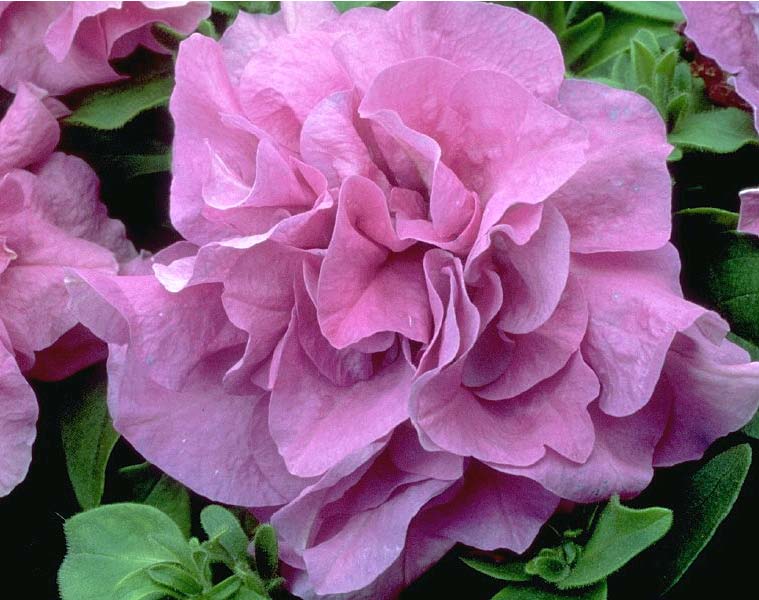
Petunia x hybrida 'Heavenly Lavender'
Garden Petunia
Garden Petunia
Type Annual
Height 10" to 12" / 25cm to 30cm
Spread 18" to 24" / 45cm to 60cm
Growth rate Average
Form Rounded
Exposure Full sun
Bloom Color Lavender
Bloom Time Spring through Fall
The flowers are fragrant and suitable for cut flowers.
Environment
This plant will grow in moist soil.
Suitable soil is well-drained/loamy, sandy or clay.
The pH preference is a neutral soil.
Leaf Color Green
This plant has fragrant foliage.
Culture Notes
'Heavenly Lavender' was chosen by All-America Selections as a 1996 bedding plant winner. These double-flowered plants are more compact and branching in full sun. Removal of spent flowers encourages more blooms. Stem cuttings can be taken and rooted in the summer.
Petunia x hybrida 'Fantasy Pink Morn'
Garden Petunia
Garden Petunia
Type Annual
Height 10" to 12" / 25cm to 30cm
Spread 12" to 18" / 30cm to 45cm
Growth rate Average
Form Rounded
Exposure Full sun
Height 10" to 12" / 25cm to 30cm
Spread 12" to 18" / 30cm to 45cm
Growth rate Average
Form Rounded
Exposure Full sun
Bloom Color Pink
Bloom Time Spring through Fall
The flowers are fragrant and suitable for cut flowers.
Bloom Time Spring through Fall
The flowers are fragrant and suitable for cut flowers.
Environment
This plant will grow in moist soil.
Suitable soil is well-drained/loamy, sandy or clay.
The pH preference is a neutral soil.
This plant will grow in moist soil.
Suitable soil is well-drained/loamy, sandy or clay.
The pH preference is a neutral soil.
Leaf Color Green
This plant has fragrant foliage.
Culture Notes
'Fantasy Pink Morn' was chosen by All-America Selections as a 1996 bedding plant winner. This petite petunia is about 2/3 the size of a normal petunia. It has light pink blossoms with creamy white centers and prefers a sunny, well-drained soil. Unlike other petunias, this plant does not require pruning mid season to maintain a compact shape. Cultivars are not reliable from seed. Stem cuttings can be taken and rooted in the summer.
Subscribe to:
Posts (Atom)