Thursday, December 4, 2014

Featured Plant of The Day: 'Pyramidalis' Eastern Red Cedar

Juniperus virginiana 'Pyramidalis'
    Eastern Red Cedar,  Silver Cedar,  Burk Eastern Red Cedar,  Silver Eastern Red Cedar

Type    Tree, woody plant
Hardy range    2B to 9A
Height    25' to 40' / 7.60m to 12.20m
Spread    12' to 20' / 3.60m to 6.00m
Growth rate    Fast
Form    Pyramidal and vase shaped
Exposure    Partial shade or partial sun to full sun
Persistence    Evergreen

Bloom Color    Green and yellow
Bloom Time    Spring

Environment
This plant tolerates drought and salt well.
This plant will grow in very dry soil.
Suitable soil is well-drained/loamy, sandy or clay.
The pH preference is an acidic to alkaline (less than 6.8 to more than 7.7) soil.

Leaf Color    Blue and green
Fall Color    No change in fall color
This plant has fragrant foliage.

Landscape Uses
-    Screen
-    Specimen

Attributes and Features
-    Attracts birds
-    Inconspicuous blooms
-    Persistent fruit
-    Attractive fruit
-    Fruit is edible by birds

This plant is best when trained to a dominant trunk.
This plant typically grows with one trunk.

Culture Notes
Planted in full sun or partial shade, Eastern Red Cedar will easily grow on a variety of soils, including clay, but will not do well on soils kept continually moist.  Growth may be poor in landscapes which are over-irrigated.  Plants are difficult to transplant due to a coarse root system, except when quite small.  Water until well-established and then forget about the tree.  It performs admirably with no care, even on alkaline soil and along the coast.  Usually insects and diseases are not a problem if grown in the full sun.

There may be local restrictions on planting this tree near apple orchards because it is the alternate host for cedar-apple rust. There is a broad group of plant forms within this cultivar name. Prune to one leader to help prevent the tree from splitting in ice storms.

Natural habitat is dry and windy with full sun exposure.  It looks best in an open site with no shade during the day.  This allows the foliage to dry quickly in the morning and helps prevent foliage disease from thinning the canopy.  A well-drained soil is essential for good growth.  Wet soil rots the roots and causes plant decline.

Plants serve as hosts for swedner's hairstreak (Mitoura gryneus swedneri) butterfly larvae.

Planting and establishing shrubs
The most common cause of young plant failure is planting too deep.  Plant the root ball no deeper than it was in the nursery.  In most instances, the root flare zone (point where the top-most root in the root ball originates from the trunk) should be located just above the landscape soil surface. Sometimes plants come from the nursery with soil over the root flare. If there is soil over this area, scrape it off.  The planting hole should be at least twice the width of the root ball, preferably wider.  In all but exceptional circumstances where the soil is very poor, there is no need to incorporate anything into the backfill soil except the loosened soil that came out of the planting hole.  Never place ANY soil over the root ball. If a row or grouping of plants is to be installed, excavating or loosening the soil in the entire bed and incorporating organic matter enhances root growth and establishment rate.

Weed suppression during establishment is essential.  Apply a 3-inch thick layer of mulch around the plant to help control weed growth.  Keep it at least 10 inches from the trunk.  If you apply it over the root ball, apply only a one or two inch layer.   This allows rainwater and air to easily enter the root ball and keeps the trunk dry.  Placing mulch against the trunk or applying too thick a layer above the root ball can kill the plant by oxygen starvation, death of bark, stem and root diseases, prevention of hardening off for winter, vole and other rodent damage to the trunk, keeping soil too wet, or repelling water.  Regular irrigation through the first growing season after planting encourages rapid root growth, which is essential for quick plant establishment.


Wednesday, December 3, 2014

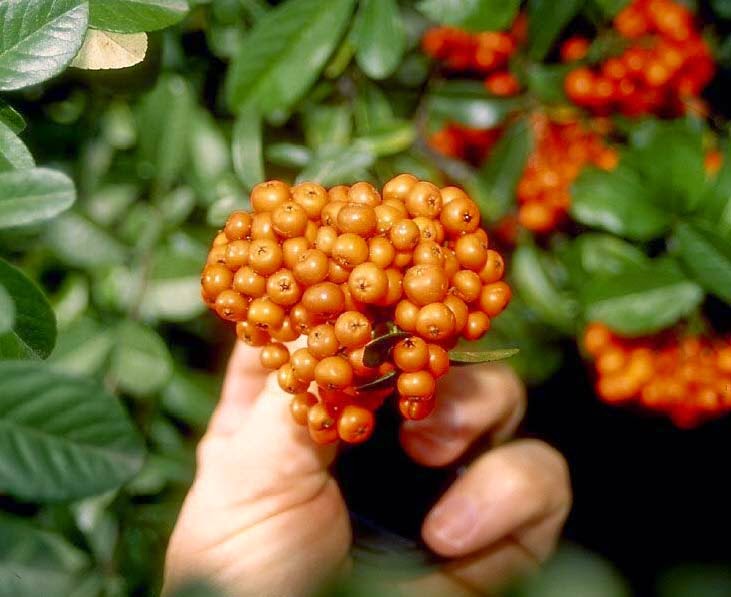
Featured Plant of The Day: 'Mohave' Pyracantha

Pyracantha coccinea 'Mohave'
Firethorn,  Pyracantha

Type    Shrub, woody plant
Hardy range    6B to 10A
Height    6' to 10' / 1.80m to 3.00m
Spread    10' to 15' / 3.00m to 4.60m
Growth rate    Fast
Form    Upright or erect
Exposure    Partial shade or partial sun to full sun
Persistence    Evergreen

Bloom Color    White
Bloom Time    Spring

The flowers are showy.

Environment
This plant tolerates drought, occasional wetness and a little salt.
This plant will grow in very dry to occasionally wet soil.
Suitable soil is well-drained/loamy, sandy or clay.
The pH preference is an acidic to alkaline (less than 6.8 to more than 7.7) soil.

Leaf Color    Green
Fall Color    No change in fall color

Landscape Uses
-    Seashore planting
-    Arbor
-    Espalier
-    Massing
-    Erosion control

Attributes and Features
-    Attracts butterflies
-    Persistent fruit
-    Attractive fruit
-    Fruit is edible by birds

Culture Notes
Surviving best in full sun and well-drained soil, pyracantha is slightly salt-tolerant.  Flowers are borne on last year's wood, so prune after flowering in the spring to maximize flower display.  Left to grow naturally, Firethorn will develop into a small tree or large sprawling bush with dark green leaves and long arching branches, making it ideally suited to large-scale shrubbery borders.  While sometimes grown as an espalier against a wall, Firethorn's rampant growth makes this treatment labor-intensive.  With proper training, this plant can quickly shade a wall which will reduce energy bills.  Begin this training process early and pinch often to create a well-branched plant.  Several large stems often develop, and frequent pinching prevents them from dominating the plant.

This cultivar has a very heavy fruit set.  Plants serve as hosts for butterfly larvae.

Planting and establishing shrubs 
The most common cause of young plant failure is planting too deep.  Plant the root ball no deeper than it was in the nursery.  In most instances, the root flare zone (point where the top-most root in the root ball originates from the trunk) should be located just above the landscape soil surface. Sometimes plants come from the nursery with soil over the root flare. If there is soil over this area, scrape it off.  The planting hole should be at least twice the width of the root ball, preferably wider.  In all but exceptional circumstances where the soil is very poor, there is no need to incorporate anything into the backfill soil except the loosened soil that came out of the planting hole.  Never place ANY soil over the root ball. If a row or grouping of plants is to be installed, excavating or loosening the soil in the entire bed and incorporating organic matter enhances root growth and establishment rate.

Weed suppression during establishment is essential.  Apply a 3-inch thick layer of mulch around the plant to help control weed growth.  Keep it at least 10 inches from the trunk.  If you apply it over the root ball, apply only a one or two inch layer.   This allows rainwater and air to easily enter the root ball and keeps the trunk dry.  Placing mulch against the trunk or applying too thick a layer above the root ball can kill the plant by oxygen starvation, death of bark, stem and root diseases, prevention of hardening off for winter, vole and other rodent damage to the trunk, keeping soil too wet, or repelling water.  Regular irrigation through the first growing season after planting encourages rapid root growth, which is essential for quick plant establishment.

Pests, Diseases and Damaging Agents
Pests:  Aphids suck plant juices and coat the leaves with sticky honeydew.  Hawthorn lace bug discolors the foliage and leaves black flecks on the undersides of leaves.  Mites cause yellowish foliage, and heavy infestations form fine webbing.

Diseases: Resistant to fireblight and scab in many situations. Fire blight causes wilting and blackening of shoots.  Scab causes dark areas on the leaves that turn yellow, then brown, then drop off.  Rake up and destroy infected leaves.

Monday, December 1, 2014

Featured Plant of The Day: Atlantic White Cedar

Chamaecyparis thyoides 'Ericoides'
White Cypress,  Atlantic White Cedar,  Coast White Cedar,  Southern White Cedar

Type    Shrub, woody plant
Hardy range    4A to 9A
Height    10' to 15' / 3.00m to 4.60m
Spread    36" to 4' / 90cm to 1.20m
Growth rate    Average
Form    Columnar and oval
Exposure    Partial shade or partial sun to full sun
Persistence    Evergreen

 Bloom Time    Spring

 Environment
This plant tolerates some drought and occasional wetness.
This plant will grow in dry to occasionally wet soil.
Suitable soil is well-drained/loamy, sandy or clay.
The pH preference is an acidic to neutral (less than 6.8 to 7.2) soil.

Leaf Color    Blue
Fall Color    No change in fall color

Landscape Uses
-    Container plantings
-    Rock garden
-    Border
-    Screen
-    Specimen

Attributes and Features
-    Wetlands plant
-    Attracts birds
-    Inconspicuous blooms
-    Inconspicuous fruit

This plant can be trained to a single trunk.
Little pruning is required.


Culture Notes
White cedar should be grown in full sun in moist, well-drained soil but plants will gladly adapt to wet, boggy sites which are similar to their native habitat of fresh-water swamps or stream banks.  It is probably best used on sites which are similar to its native wetland habitat, although it adapts to a landscape nicely.  Pollen can cause significant allergenic reactions in certain people.
 
Tree establishment specifications

Choose good quality trees for planting. The most common cause of young tree failure is planting too deep.  In most instances, the point where the top-most root in the root ball originates from the trunk (referred to as the root flare zone or root collar) should be located just above the soil surface.  You may have to dig into the root ball to find the root flare. If there is nursery soil over this area, scrape it off. Never place ANY soil over the root ball. The planting hole should be at least twice the width of the root ball, preferably wider because roots grow best in loose soil.  In all but exceptional circumstances where the soil is very poor, extensive research clearly shows that there is no need to incorporate any amendments into the backfill soil. Simply use the loosened soil that came out of the planting hole. Simply planting with the topmost portion of the root ball slightly higher than the surrounding soil might still install the tree too deep - be sure to locate the root flare.

Weed suppression during establishment is essential.  Apply a 3-inch thick layer of mulch to at least a six-foot diameter circle around the tree. This area should be at least two feet in diameter for each inch of tree trunk diameter and maintained during the establishment period.  Apply a thinner layer of mulch directly over the root ball but keep it at least 10 inches from the trunk. This allows rainwater, irrigation and air to easily enter the root ball and keeps the trunk dry.  Placing mulch against the trunk and applying too thick a layer above the root ball can kill the plant by oxygen starvation, death of bark, stem and root diseases, prevention of hardening off for winter, vole and other rodent damage to the trunk, keeping soil too wet, or repelling water.

Regular irrigation after planting encourages rapid root growth that is essential for tree establishment.  Trees provided with regular irrigation through the first growing season after transplanting require about 3 months (hardiness zones 9-11), 6 months (hardiness zones 7-8), or one year or more (hardiness zones 2-6) per inch of trunk diameter to fully establish roots in the landscape soil. Trees in desert climates may take longer to establish.  Trees that are under-irrigated during this establishment period (and most trees are) often require additional time to establish because roots grow more slowly.   Be prepared to irrigate through the entire establishment period, especially during periods of drought.

Irrigation also helps maintain and encourage the desirable dominant leader in the tree canopy on large-maturing trees.  Instead of a dominant leader, trees that are under-irrigated during the establishment period often develop undesirable, low, co-dominant stems and double leaders that can split from the tree later.

Unlike established plants, which do best with deep, infrequent irrigation, research clearly shows that recently transplanted trees and shrubs establish quickest with light, frequent irrigation.  For trees planted in spring or summer, provide one (cooler hardiness zones) to three irrigations (warmer hardiness zones) each week during the first few months after planting.  Daily irrigation in the warmest hardiness zones provides the quickest establishment.  Following the initial few months of frequent irrigation, provide weekly irrigation until plants are fully established.  With every irrigation, apply one (cool climates) to two (warm climates) gallons of water per inch trunk diameter (e.g. 2 to 4 gallons for a 2-inch tree) over the root ball only.  In most landscapes that receive more than 30 inches of rain or irrigation annually, if the mulch area is maintained weed-free, irrigation does not need to be applied outside of the root ball.  Never add water if the root ball is saturated.

In cooler hardiness zones, in all but the driest years, irrigation of spring- and summer-planted trees usually can be discontinued once fall color has begun. Irrigation of fall planted trees, however, should be continued until foliage has dropped from the deciduous trees in the region.  In warmer climates, irrigate fall-and winter-planted trees as described for the spring- and summer-planted trees.

In drier, desert climates there is benefit to be gained from applying additional irrigation outside of the root ball area. This is best done by making a large diameter berm four to six inches high, then filling it with water so it percolates into the soil.  For the first two years, irrigate twice each week through the spring, once per week in summer provided monsoons arrive, and twice each week again in fall if it remains warm.  Taper off watering to once or twice each month in winter and resume twice weekly next spring.  For years three to five, water twice per month in spring, summer, and fall and once or twice per month in winter.  During years five through seven, water once every three weeks in warm weather and once every six weeks in winter.  After this, the drought-tolerant desert trees should be able to survive on natural rainfall.

Trees with good, strong structure need no pruning at planting, except to remove broken twigs.  Do not remove branches to compensate for root loss - research has shown that this can be detrimental to establishment.

Wednesday, November 26, 2014

Featured Plant of The Day: 'Berry Nice' Winterberry Holly

Ilex verticillata 'Spriber (Berry Nice™)'
Winterberry,  Black Alder,  Holly

Type    Shrub, woody plant
Hardy range    4A to 9A
Height    6' to 8' / 1.80m to 2.40m
Spread    4' to 5' / 1.20m to 1.60m
Growth rate    Slow
Form    Rounded and vase shaped
Exposure    Partial shade or partial sun to full sun
Persistence    Deciduous

Bloom Color    White
Bloom Time    Spring

Environment
This plant tolerates flooding.
This plant will grow in wet or submerged soil.
Suitable soil is well-drained/loamy, sandy or clay.
The pH preference is an acidic to neutral (less than 6.8 to 7.2) soil.

Leaf Color    Green
Fall Color    No change in fall color

Landscape Uses
-    Woodland garden
-    Screen
-    Massing
-    Specimen

Attributes and Features
-    Pest tolerant
-    Wetlands plant
-    Attracts birds
-    Attracts butterflies
-    Inconspicuous blooms
-    Persistent fruit
-    Attractive fruit
-    Fruit is edible by birds

Culture Notes
When planted in turf as a specimen, be sure to keep the soil under the canopy mulched so weeping stems and branches can droop to display the nice form.  If turf is allowed to grow beneath the crown, it will thin due to the dense shade and low branches will interfere with mowing equipment.  Little pruning is needed if the plant is properly located to allow for its spread.  The plant grows in sun or partial shade in a rich, well-drained, acid soil, though it tolerates swampy areas.  Its tolerance to wet soil makes this a useful plant in poorly-drained landscapes.  Berry Nice  has spectacular berry production and has good mildew resistance. 'Southern Gentlemen' is the pollinator.  Plants serve as hosts for butterfly larvae.

Planting and establishing shrubs

The most common cause of young plant failure is planting too deep.  Plant the root ball no deeper than it was in the nursery.  In most instances, the root flare zone (point where the top-most root in the root ball originates from the trunk) should be located just above the landscape soil surface. Sometimes plants come from the nursery with soil over the root flare. If there is soil over this area, scrape it off.  The planting hole should be at least twice the width of the root ball, preferably wider.  In all but exceptional circumstances where the soil is very poor, there is no need to incorporate anything into the backfill soil except the loosened soil that came out of the planting hole.  Never place ANY soil over the root ball. If a row or grouping of plants is to be installed, excavating or loosening the soil in the entire bed and incorporating organic matter enhances root growth and establishment rate.

Weed suppression during establishment is essential.  Apply a 3-inch thick layer of mulch around the plant to help control weed growth.  Keep it at least 10 inches from the trunk.  If you apply it over the root ball, apply only a one or two inch layer.   This allows rainwater and air to easily enter the root ball and keeps the trunk dry.  Placing mulch against the trunk or applying too thick a layer above the root ball can kill the plant by oxygen starvation, death of bark, stem and root diseases, prevention of hardening off for winter, vole and other rodent damage to the trunk, keeping soil too wet, or repelling water.  Regular irrigation through the first growing season after planting encourages rapid root growth, which is essential for quick plant establishment.

Thursday, November 20, 2014

Featured Plant of The Day: 'Blue Shades' Greek Anemone

Anemone blanda 'Blue Shades' 
Grecian Windflower,  Greek Anemone,  Windflower


Type    Perennial
Hardy range    6A to 10A
Height    4" to 6" / 10cm to 15cm
Growth rate    Average
Form    Spreading or horizontal
Exposure    Partial shade or partial sun to full sun
Persistence    Deciduous

Bloom Color    Blue
Bloom Time    Spring and Winter

The flowers are suitable for cut flowers.

Environment
This plant will grow in moist soil.
Suitable soil is well-drained/loamy or sandy.
The pH preference is  a neutral soil.

Leaf Color    Green
This plant has attractive foliage.

Landscape Uses
-    Container plantings
-    Alpine garden
-    Rock garden
-    Border
-    Massing
-    Groundcover

Attributes and Features
-    Naturalizing
-    Attracts butterflies

Propagation and Root Form
Propagation is from  division and  seeds.
This plant grows from a  rhizome.

Culture Notes
Leave anemones undisturbed after planting.  Do not let the soil get too wet, or rotting may occur.  The flowers of the anemone close at night and during cloudy weather.  Division can be made to the tuber in fall or early spring.  This plant does self seed easily and form large colonies.