Thursday, February 6, 2014

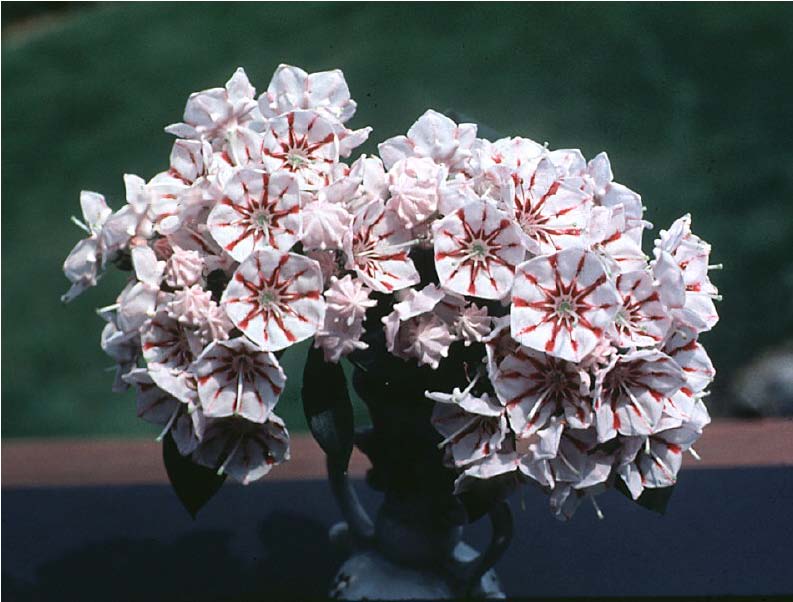
Peppermint Calico Bush Featured Plant of The Day

Kalmia latifolia 'Peppermint'
Mountain Laurel, Calico Bush, Ivy

Type Shrub, woody plant
Hardy range 4A to 8A
Height 6' to 10' / 1.80m to 3.00m
Spread 6' to 10' / 1.80m to 3.00m
Growth rate Slow
Form Oval
Exposure Full shade to full sun
Persistence Evergreen

Bloom Color Pink, red and white
Bloom Time Spring and Summer

The flowers are very showy.

EnvironmentThis plant tolerates some drought.
This plant will grow in dry soil.
Suitable soil is well-drained/loamy, sandy or clay.
The pH preference is an acidic to neutral (less than 6.8 to 7.2) soil.

Leaf Color Green
Fall Color No change in fall color

This plant has attractive foliage.

Culture Notes Mountain Laurel does best on moist, acidic soils of moderate fertility and drainage and can tolerate sunny locations, if provided with sufficient moisture and not allowed to dry out. Plants in a sunny spot flower better. Mountain Laurel is not salt tolerant. Mountain Laurel is ideally suited to natural landscapes and other low-maintenance gardens where it can be allowed to grow to its natural form and size, with pruning only to remove spent flower heads and dead branches. Provide good drainage or plants die. Like many shrubs, amending the entire planting bed, not just the planting hole, with organic matter such as pine bark or peat improves root and shoot growth.

All parts of the plant are poisonous causing watering of the eyes, nose and mouth followed by vomiting, abdominal pain, and low blood pressure. Pollen causes significant allergy. Plants perform poorly in zone 8B and south. Young plants in 3 gallon containers can be forced to produce flowers in spring with spray applications of certain growth regulators. In spring or early summer, all plant surfaces need to be covered with the spray in order to be effective. No shoot growth takes place in the growing season where they are sprayed, so perform any necessary pruning well before application.

Planting and establishing shrubsThe most common cause of young plant failure is planting too deep. Plant the root ball no deeper than it was in the nursery. In most instances, the root flare zone (point where the top-most root in the root ball originates from the trunk) should be located just above the landscape soil surface. Sometimes plants come from the nursery with soil over the root flare. If there is soil over this area, scrape it off. The planting hole should be at least twice the width of the root ball, preferably wider. In all but exceptional circumstances where the soil is very poor, there is no need to incorporate anything into the backfill soil except the loosened soil that came out of the planting hole. Never place ANY soil over the root ball. If a row or grouping of plants is to be installed, excavating or loosening the soil in the entire bed and incorporating organic matter enhances root growth and establishment rate.

Weed suppression during establishment is essential. Apply a 3-inch thick layer of mulch around the plant to help control weed growth. Keep it at least 10 inches from the trunk. If you apply it over the root ball, apply only a one or two inch layer. This allows rainwater and air to easily enter the root ball and keeps the trunk dry. Placing mulch against the trunk or applying too thick a layer above the root ball can kill the plant by oxygen starvation, death of bark, stem and root diseases, prevention of hardening off for winter, vole and other rodent damage to the trunk, keeping soil too wet, or repelling water. Regular irrigation through the first growing season after planting encourages rapid root growth, which is essential for quick plant establishment.


Please feel free to comment on any post at any time all feedback is welcome and we’d love to hear it.

Wednesday, February 5, 2014

Bar Harbor Creeping Juniper Featured Plant of The Day


Juniperus horizontalis 'Bar Harbor'
Creeping Juniper

Type    Groundcover, woody plant
Hardy range    4A to 9A
Height    2" to 4" / 5cm to 10cm
Spread    36" to 6' / 90cm to 1.80m
Growth rate    Average
Form    Prostrate and spreading or horizontal
Exposure    Full sun
Persistence    Evergreen

Environment
This plant tolerates drought and some salt.
This plant will grow in very dry soil.
Suitable soil is well-drained/loamy, sandy or clay.
The pH preference is an acidic to alkaline (less than 6.8 to more than 7.7) soil.

Leaf Color    Blue and green
Fall Color    Purple
This plant has attractive fall colors and fragrant foliage.

Culture Notes
'Bar Harbor' Juniper makes a fine-textured, dense, slow growing ground cover comprised of bright blue foliage. Foliage changes to a darker, reddish blue during the winter but new growth in the spring emerges blue.

Natural habitat is dry and windy with full sun exposure.  It looks best in an open site with no shade during the day.  This allows the foliage to dry quickly in the morning and helps prevent foliage disease from thinning the canopy.  A well-drained soil is essential for good growth.  Wet soil rots the roots and causes plant decline.

The plant is excellent for low-maintenance landscapes as it requires virtually no pruning, except along the borders of the mass planting as it reaches the edge of the landscape bed.  It is one of the best plants for cascading over a wall as the stems hug the contort of the wall.  It has also been tried as a hanging basket.  When used as a ground cover plant 3 to 4 feet apart.

`Bar Harbor' Juniper tolerates exposed sites and a wide range of soils.  Full sun makes for the most dense canopy of foliage.  It will grow in partial shade but may become thin and allow weeds to germinate in the landscape bed.  Once established, Juniper is quite drought-tolerant.  The plant is excellent for low-maintenance landscapes as it requires virtually no pruning.  When used as a ground cover plant 3 to 4 feet apart. The plant grows about 2 to 4 inches tall. 'Bar Harbor' is a female so it generates no allergy-causing pollen.

Planting and establishing shrubs

The most common cause of young plant failure is planting too deep.  Plant the root ball no deeper than it was in the nursery.  In most instances, the root flare zone (point where the top-most root in the root ball originates from the trunk) should be located just above the landscape soil surface. Sometimes plants come from the nursery with soil over the root flare. If there is soil over this area, scrape it off.  The planting hole should be at least twice the width of the root ball, preferably wider.  In all but exceptional circumstances where the soil is very poor, there is no need to incorporate anything into the backfill soil except the loosened soil that came out of the planting hole.  Never place ANY soil over the root ball. If a row or grouping of plants is to be installed, excavating or loosening the soil in the entire bed and incorporating organic matter enhances root growth and establishment rate.

Weed suppression during establishment is essential.  Apply a 3-inch thick layer of mulch around the plant to help control weed growth.  Keep it at least 10 inches from the trunk.  If you apply it over the root ball, apply only a one or two inch layer.   This allows rainwater and air to easily enter the root ball and keeps the trunk dry.  Placing mulch against the trunk or applying too thick a layer above the root ball can kill the plant by oxygen starvation, death of bark, stem and root diseases, prevention of hardening off for winter, vole and other rodent damage to the trunk, keeping soil too wet, or repelling water.  Regular irrigation through the first growing season after planting encourages rapid root growth, which is essential for quick plant establishment.


Friday, January 31, 2014

Sekkan Sugi Japanese Cedar Featured Plant of The Day


Cryptomeria japonica 'Sekkan Sugi' 
Japanese Cedar,  Sugi


Type    Tree, woody plant
Hardy range    6A to 9A
Height    25' to 40' / 7.60m to 12.20m
Spread    12' to 18' / 3.60m to 5.40m
Growth rate    Slow
Form    Oval and pyramidal
Exposure    Full sun
Persistence    Evergreen

 Environment
This plant tolerates drought.
This plant will grow in very dry soil.
Suitable soil is well-drained/loamy, sandy or clay.
The pH preference is an acidic to neutral (less than 6.8 to 7.2) soil.

 Leaf Color    Green and yellow
Fall Color    Copper
This plant has attractive foliage.

 Culture Notes
This is one of the nicest cultivars with medium green foliage that appears to be disease resistant. Provide a well-drained acid soil and protection from winter winds in the north. Locate the tree so air circulation is good, particularly during summer to help prevent leaf blight. Best with afternoon shade in southern part of its range. Many cultivars are available varying in growth habit and ability to hold green foliage color in the winter. This one holds green color well. Little pruning is need to develop into the form shown in the photograph. There are so many cultivars one has to wonder why we need more.

Cryptomeria is tolerant of compacted soil and performs well in parking lots and other tough, urban sites with some irrigation in drought.  It makes a wonderful accent, screen, or border tree for larger properties.  It may grow too large for most residential landscapes.  They can be planted as street trees 10 feet back from the street in residential areas to provide an elegant flavor to the neighborhood.

Maintain adequate mulch area

Be sure to clear all turf away from beneath the branches and mulch to the drip line (the edge of the branches), especially on young trees, to reduce competition with turf and weeds.  This will allow roots to become well established and keep plants healthier.  Locate the tree properly, taking into account the ultimate size, since the tree looks best if it is not pruned to control size.  The tree can enhance any landscape with its delightful spring flush of foliage.  It can be the centerpiece of your landscape if properly located.

Tree establishment specifications

Choose good quality trees for planting. The most common cause of young tree failure is planting too deep.  In most instances, the point where the top-most root in the root ball originates from the trunk (referred to as the root flare zone or root collar) should be located just above the soil surface.  You may have to dig into the root ball to find the root flare. If there is nursery soil over this area, scrape it off. Never place ANY soil over the root ball. The planting hole should be at least twice the width of the root ball, preferably wider because roots grow best in loose soil.  In all but exceptional circumstances where the soil is very poor, extensive research clearly shows that there is no need to incorporate any amendments into the backfill soil. Simply use the loosened soil that came out of the planting hole. Simply planting with the topmost portion of the root ball slightly higher than the surrounding soil might still install the tree too deep - be sure to locate the root flare.

Weed suppression during establishment is essential.  Apply a 3-inch thick layer of mulch to at least a six-foot diameter circle around the tree. This area should be at least two feet in diameter for each inch of tree trunk diameter and maintained during the establishment period.  Apply a thinner layer of mulch directly over the root ball but keep it at least 10 inches from the trunk. This allows rainwater, irrigation and air to easily enter the root ball and keeps the trunk dry.  Placing mulch against the trunk and applying too thick a layer above the root ball can kill the plant by oxygen starvation, death of bark, stem and root diseases, prevention of hardening off for winter, vole and other rodent damage to the trunk, keeping soil too wet, or repelling water.

Regular irrigation after planting encourages rapid root growth that is essential for tree establishment.  Trees provided with regular irrigation through the first growing season after transplanting require about 3 months (hardiness zones 9-11), 6 months (hardiness zones 7-8), or one year or more (hardiness zones 2-6) per inch of trunk diameter to fully establish roots in the landscape soil. Trees in desert climates may take longer to establish.  Trees that are under-irrigated during this establishment period (and most trees are) often require additional time to establish because roots grow more slowly.   Be prepared to irrigate through the entire establishment period, especially during periods of drought.

Irrigation also helps maintain and encourage the desirable dominant leader in the tree canopy on large-maturing trees.  Instead of a dominant leader, trees that are under-irrigated during the establishment period often develop undesirable, low, co-dominant stems and double leaders that can split from the tree later.

Unlike established plants, which do best with deep, infrequent irrigation, research clearly shows that recently transplanted trees and shrubs establish quickest with light, frequent irrigation.  For trees planted in spring or summer, provide one (cooler hardiness zones) to three irrigations (warmer hardiness zones) each week during the first few months after planting.  Daily irrigation in the warmest hardiness zones provides the quickest establishment.  Following the initial few months of frequent irrigation, provide weekly irrigation until plants are fully established.  With every irrigation, apply one (cool climates) to two (warm climates) gallons of water per inch trunk diameter (e.g. 2 to 4 gallons for a 2-inch tree) over the root ball only.  In most landscapes that receive more than 30 inches of rain or irrigation annually, if the mulch area is maintained weed-free, irrigation does not need to be applied outside of the root ball.  Never add water if the root ball is saturated.

In cooler hardiness zones, in all but the driest years, irrigation of spring- and summer-planted trees usually can be discontinued once fall color has begun. Irrigation of fall planted trees, however, should be continued until foliage has dropped from the deciduous trees in the region.  In warmer climates, irrigate fall-and winter-planted trees as described for the spring- and summer-planted trees.

In drier, desert climates there is benefit to be gained from applying additional irrigation outside of the root ball area. This is best done by making a large diameter berm four to six inches high, then filling it with water so it percolates into the soil.  For the first two years, irrigate twice each week through the spring, once per week in summer provided monsoons arrive, and twice each week again in fall if it remains warm.  Taper off watering to once or twice each month in winter and resume twice weekly next spring.  For years three to five, water twice per month in spring, summer, and fall and once or twice per month in winter.  During years five through seven, water once every three weeks in warm weather and once every six weeks in winter.  After this, the drought-tolerant desert trees should be able to survive on natural rainfall.

Trees with good, strong structure need no pruning at planting, except to remove broken twigs.  Do not remove branches to compensate for root loss - research has shown that this can be detrimental to establishment.


Thursday, January 30, 2014

Testimonial


Subject: Patio

Hi:

Every new patio looks great the summer it’s installed.  The real test is how it looks the first winter and following summer.  Over the past few weeks we’ve seen snow, frigid cold and a decent amount of rain.  Several times we have looked into the backyard and said how beautiful the yard looks even in the dead of winter.  For us, that’s the real test of an outstanding design.


Well done guys, we’re still loving the work you did for us.  Even in the dead of winter.

Best,

Hugh

Ice Plant (Delosperma Cooperi) Featured Plant of The Day


Delosperma cooperi
    Ice Plant,  Trailing Ice Plant

Type    Annual, perennial, succulent
Height    2" to 4" / 5cm to 10cm
Spread    18" to 36" / 45cm to 90cm
Growth rate    Fast
Form    Prostrate and spreading or horizontal
Exposure    Full sun

Bloom Color    Pink
Bloom Time    Year 'round

The flowers are showy.

Environment
This plant tolerates drought.
This plant will grow in dry to moist soil.
Suitable soil is well-drained/loamy, sandy or clay.
The pH preference is an acidic to neutral (less than 6.8 to 7.2) soil.

Leaf Color    Green and silvery
This plant has attractive foliage.

Culture Notes
Plants will flower nearly all year long.  Propagate by seeds or cuttings.  These plants will need mulch or some protection when the temperature nears 0 degrees.  D. cooperi blooms best during the hottest part of the year.  Contrary to most ice plants, D. cooperi can tolerate humidity. Spring cut dead foliage only, and allow plants to dry out between waterings.  The attractive, succulent foliage and pink, daisy-like blossoms of D. cooperi make an excellent look when used as a groundcover.